
Blog Archives
Degradinite
| January 29, 2013 | Filled under Com I |
|
Introduction
The Degradinite WG commenced in 2002 following the 54th ICCP Meeting in Maputo. The aim was to provide a recommendation to Commission I as to whether or not the term degradinite and its associated microlithotypes hydrite should be formally reinstated into the ICCP classification system.
Review of New Methodologies and Techniques in Organic Petrology
| January 29, 2013 | Filled under Com I |
|
Introduction
A working group on “New Methodologies and Techniques in Organic Petrology” was established within Commission I at the 52nd ICCP meeting in Rio de Janeiro, August 2000. The Working Group was set up to review new methods and techniques that may be of assistance in advancing the science of coal petrology, to familiarise ICCP members with the principles and operation of these techniques, and to indicate to members the application of advanced techniques in coal petrology studies.
Objectives
The main objective of the Working Group is to provide an update on novel and new methods and techniques that can be applied to Coal and Organic Petrology, including the elemental and organic chemistry of coal macerals, the nature of coal minerals, maturation studies, coal-combustion problems and environmental issues.
Activities
- As the first action of the Working Group, presentations were given at the 2000 meeting in Rio de Janeiro on confocal laser scanning fluorescence microscopy by Lavern Stasiuk and fluorescence alteration of multiple macerals (FAMM) by Walter Pickel.
- For the 2001 meeting in Copenhagen a series of presentations were given on topics related to many aspects of organic matter/mineral matter interactions in coal by Petra David (image analysis), Miryam Glikson (TEM) and Colin Ward (XRD).
- The first version of the White Paper, with a description of several novel methods and techniques was presented at the 53rd ICCP meeting in Copenhagen, Denmark, August 2001. The White Paper is dedicated to the memory of Marlies Teichmüller and Alex Cameron, and includes extended abstracts of the presentations given by invited speakers in the Rio and Copenhagen meetings. The White Paper contains the following contribution:
·Pickel, W., Wilkins, R., Buckingham, C., Faiz, M., Kurusingal, J., Russel., N. and Sherwood, N.: Laser Microscopy – FAMM.
·Stasiuk, L.: Confocal laser scanning fluorescence microscopy – summary.
·David, P., Veld, H., Reimer, K. and Raab, C.: Investigation on the organic/mineral matter association and distribution in coal using Colour Image Analysis.
·Glikson, M: Transmission Electron Microscopy (tem), as a tool in characterising organic matter further to organic petrology.
·Ward, C. R.: Quantitative mineralogical analysis of coal using advanced x-ray diffraction techniques.
·Mastalerz, M.: Application of reflectance micro-Fourier Transform infrared (FTIR) analysis to the study of coal macerals.
·Radlinski, A. P.: Applications of Small Angle Neutron Scattering and Small Angle X-ray Scattering to Organic Petrology.
- The White Paper gives the opportunity to publicize the research and gives information about recent international progress in individual research fields A copy of the White Paper is available from the ICCP web-site. The White Paper is open to further contributions. The next update of the White Paper will be prepared following the 61st meeting in Gramado, Brazil.
- In 2003, at the meeting of the 55th ICCP meeting in Utrecht, Netherland, a presentation was given on A new optical and/or image based technique for characterisation of coal/biomass blends before and after milling. The presentation was prepared by Helen Beath and Graham O’Brien from CSIRO, Australia, and presented by the Convenor of the Working Group.
- In 2005 the Convener made a presentation about a new technique for Coal and Mineral Matter Characterisation – QEMSCANTM, developed by CSIRO and Intellection (Australia), in collaboration with the CRC (Cooperative Research Centre) for Coal in Sustainable Development.
QEMSCAN is a methodology whereby coal characteristics such as mineralogy, particle size distribution and mineral association can be measured automatically using a Scanning Electron Microscope (SEM) with a combination of BSE and EDS x-rays to identify, quantify and characterise materials.
The advantages of this new technique as well as details concerning the sample preparation, calibration and measurement parameters were discussed. These include: number and size range of particles to be measured, magnification of the run, spatial and chemical resolution desired, and geometric arrangement of the frames to be scanned. This technique also allows to select which type of measurement mode is required, which includes: point scan, area scan, line scan or frame scan. Multiple modes of measurement can be scheduled within the same run.
This system automatically delineates particles from the mounting media, and then scans each particle found according to the measurement protocols requested. The most common mode used in coal applications is Particle Mineralogical Analysis (or PMA) mode, where the beam scans across each particle and builds up a map of the minerals present.
In the coal industry QEMSCANTM has application in the following areas:
·Coal exploration for seam correlation and coal characterisation for identification of utilisation options;
·Coal preparation for determining efficiency of washery plants and selective mineral removal;
·Characterisation of coal utilisation by-products with respect to waste management, leaching behaviour and utilisation;
·The behaviour of coal and mineral during combustion in advanced power generation technologies such as supercritical and ultra-supercritical pf combustion, FBC and IGCC;
·Coke production and the behaviour of coke in the blast furnace;
·The behaviour of coal and mineral matter during gasification;
·Characterisation of particulate emissions arising from coal production and utilisation.
- In 2006, at the 59th meeting in Victoria, on behalf of the Convenor, Dr Zhongsheng Li presented a talk on the new advances on Electron Microprobe Analysis and Micro-FTIR of macerals and their applications in coal utilization.
Variations in the elemental composition of macerals in coals over a wide range of coal ranks, using light-element electron microprobe techniques, to establish the coalification tracks of key macerals in a single coal-bearing interval from sub-bituminous through bituminous coal to anthracite have been studied and presented. Attenuated total reflectance micro-Fourier transform infrared (ATR-FTIR) spectrometry has been used to characterise coal macerals, in particular telocollinite, changes in the aromatic and aliphatic functional groups, over a wide rank range in coals. Inorganic elements were found in electron microprobe studies of coal macerals, especially vitrinite macerals, without any visible minerals or mineral inclusions in the macerals concerned.
Detailed mapping of the concentration of these elements in macerals of several low-rank coals reveals that a majority of inorganic elements occur as non-mineral entities rather than discrete mineral particles, and are intimately distributed throughout the macerals; the distribution of these elements is very similar to that of organic S, particularly in the collotelinite and fusinite of the same coal samples.
Further, the applications of these studies in coal utilization such as: Coal Utilisation, Ultra-clean Coal Combustion, as well as CBM production and CO2 sequestration in coal seams, were presented. Finally, these studies permitted to draw the following conclusions:
Microprobe analysis can indicate:
•Coalification tracks of macerals with rank advance
•Rank in coals with suppressed reflectance
•Inorganic elements that may react unfavourably in combustion or gasification or may survive demineralisation processes
•Detailed nature of cleat and other mineralisation that may affect gas drainage or CO2 sequestration
•Micro-FTIR of macerals may further identify: Functional groups in different macerals, including aliphatic/aromatic characteristics of vitrinites with normal and suppressed reflectance
Applications
•Calcium may be a problem in slagging, but may have favorable catalytic effects in gasification Processes .
The Convenor wishes to encourage everybody who is working on new methodologies and/or developing novel techniques related to organic petrology, to share knowledge and submit an extended abstract, short communication or paper as a contribution to the White Paper II. Interested members should contact the Convenor.
White Paper
The White Paper is dedicated to the memory of Marlies Teichmuller and Alex Cameron, and includes extended abstracts of the presentations given by invited speakers in Rio and Copenhagen meetings.
Standardization
| January 29, 2013 | Filled under Com I |
|
Introduction
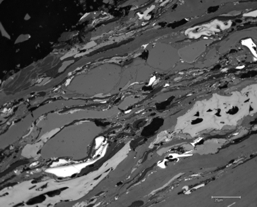
Photomicrograph of RIC08 round robin sample (Australia, Bowen Basin)
The Standardization WG is the longest running working group of Commission I and its objectives have been adapted over the time moving the focus according to the new developments in definitions and methodology. The main objectives can be summarized as:
- Organize and evaluate round robin exercises related to analysis procedures, recent discussions and definitions/classifications established or to be established by the ICCP.
- Contribute to the revision of the existing standards for petrographic analysis of organic rocks
The working group has been holding round robins on lignite, sub-bituminous and bituminous coals with varying emphasis. Reflectance analysis, maceral group, maceral sub-group and maceral analyses or a round robin on a set of glass standards were topics of the ring analyses. The results from the round robins inter alia established experimental data for the reproducibility, contributed to the idea of the ICCP Accreditation Program and caused the ICCP to have its own reflectance standards against which other standards can be calibrated.
The working group was originally convened Carl Ottenjann (as the Standardization of Analyses Working Group) then by the late Werner Pfisterer followed by the late Walter Pickel, Harold Read, Walter Pickel and Ivana Sykorova and in 2022 by Stavros Kalaitzidis replacing Walter.
Recent Activities
2022 A review of the ICCP contribution to the development of standard procedures, which is an updated of the plenary talked given by A.G. Borrego in The Hague Meeting was presented within the WG during the Meeting in India. It was agreed that A.G. Borrego and Stavros Kalaitzidis will co-convene the WG.
2023. The ICCP has formally established a category C liaison with ISO and the new convener of the Standardization W.G. (A.G. Borrego) will be the contact person with ISO in addition to the President. A.G. Borrego attended the ISO TC27/SC5 meeting in Delft representing ICCP where it was established to open again the revision of the 5 ISO 7404 standards dealing with petrographic analysis of coals. Feedback on a proposal presented to ISO TC27/SC5 WG14 by Kazakhstan delegation to establish the level of oxidation of a coal using petrographic methods has been provided to ISO.
For 2023-2024 an exercise is also prepared based on photomicrographs, in which the participants will have to identify macerals of lignite rank samples.
2025. Microlithotype analysis
An online survey has been developed and is addressed to any ICCP member who has ever performed a microlithotype analysis or is familiar with the procedure. It is important in order to adapt the standard to the actual practice. It will only take three minutes. Please follow the link: Questionnaire about microlithotype analysis
Historical Development
At the meeting in Oviedo 1983, the structure of the Standardization WG within Commission I was established as having three main activities:
- Maceral/Reflectance (W. Pfisterer) The maceral/Reflectance branch focused on relevance of calibration and performing Round Robin exercises on Vitrinite Reflectance and maceral analysis to test reproducibility. RIC83, RIC85, RIC87 were conducted showing that vitrinite reflectance results were close to ISO reproducibility limits. Since 1991 W. Pickel took over the convenorship dealing essentially with reproducibility of maceral analysis and vitrinite reflectance. A split of the standardization W.G. focusing on the establishment of the Accreditation Program was convened by R. Kutzner (see Historical Development of ICCP Accreditation Programs). In the forthcoming exercises (RIC92, RIC93, RIC99) the Vitrinite classification ICCP1994 system was used. In general, vitrinite reflectance results were closer to each other than maceral analysis results. The agreement was good at maceral group level but discrepancies increased at maceral subgroup and maceral level. No improvement was observed in successive exercises.
The activities of the W.G. on reproducibility of Maceral analysis continued under the convenorship of H. Read since 1999. The objectives focused on:
i) Verification of the new vitrinite, inertinite and liptinite classifications. Under this objective the following Round Robin exercises were carried out:
RIC2000 (Australian medium volatile bituminous coal) few analysts replied but a difficulty in distinguishing semifusinite and fusinite became clear. Results are summarized in ICCPNews25 (2001).
RIC2003 (Inertinite-rich Australian medium volatile bituminous coal). Quite poor results attributed partially to instructions not precise enough
RIC2005 (2 Greek Lignites) to test the Huminite classification ICCP System 1994 (ICCPNews36, 2005). Overall good agreement for maceral groups and vitrinite reflectance but poor agreement for macerals and subgroups. Work should concentrate on improving the definitions for major macerals, eg fusinite/semifusinite; collotelinite/ collodetrinite, etc.
RIC2008 (Gregory, Bowen Basin, Queensland (AU) German Creek Seam. Late Permian. Medium Rank B-C according to ISO 11760). I. Sýkorová joint W. Pickel as convenor for this exercise. As reported in the ICCPNews48 (2009), 22 participants reported results and agreement was good at maceral group level but very poor at maceral sub-group level essentially because of the misinterpretation of the meaning of gelification (gelo-vitrinite) in the medium rank stage. The discussion on a collection of images provided proved to be useful and it was decided to run an exercise on microscopy images of the same coal.
RIC2010. The same coal used in RIC2008 was used to obtain the images for this exercise. The exercise consists of a pdf file with images with marked fields that the participant is expected to assign to a vitrinite subgroup: telovitrinite, detrovitrinite or gelovitrinite according to vitrinite 1994 ICCP system (ICCP; 1998: The New Vitrinite Classification (ICCP System 1994) – Fuel, 77: 349-358). The exercise also consist of an excel sheet where the participant is expected to report the results and send them back to the organizer and detailed instructions to perform the exercise. It is possible to run this exercise (contact angeles@incar.csic.es).
RIC2016. Two lignite samples from the Lausitz Lignite District, Open Cast Nochten, 2nd Lausitzer Main Seam, Miocene, kindly supplied by Claudia Niemtz from Vattenfall AB, were distributed for analysis. The samples were very difficult and reproducibility of results were very poor.
ii) Assist ISO in the revision of the ISO 7404 standard methods. This activity incorporated within the objectives of the WG at the meeting in 1999. At the Meeting in Patras (2005) three contact persons were established for each of the standards under revision: part 2-sample preparation (D. Pearson); part 3-maceral group composition (H. Read) and part 5-Measurement of vitrinite reflectance (W. Pickel). At the time of the Bandung Meeting (2006) the three standards under discussion were ready. Part 2 revision included solid media for preparation of samples. Part 3 revision succeeded in its objective to cover coals of all ranks, but failed to expand coverage to include maceral subgroups and macerals. These 3 standards were finally published in 2009.
At the meeting in Beijing (2012) the revision of part 1-Vocabulary by ISO has been formally initiated, but it was not clear if the part 4-microlithotype analysis was worth to be revised. After the discussion held in Commission I, it was agreed to ask ISO to formally initiate the process. The contact person was H. Read. The revised version of part 1 incorporating the ICCP 1994 System for vitrinite, huminite, inertinite and liptinite was published in 2016. The revised version of part 4 without considering the rule of 5% for purity of the microlithotypes was published in 2017. ISO formally approved the revision of part 2-, 3- and 5- in order to incorporate last advancements in microscopy. The chair of ISO TC27/SC5 WG14 dealing with petrographic analysis of coals was W. Pickel and therefore a smooth transfer of the ICCP knowledge into the ISO WG14 was guaranteed.
At the Meeting in The Hague (2019) it was discussed again the convenience of having an ICCP representative in ISO WG14 formally bringing to ISO the view of the ICCP. This was attempted during A. C. Cook presidency and a formal liaison was established but without resulting in a continuous exchange with ISO WGs.
The unexpected passing of W. Pickel in 2022 caused the cancellation of the ISO 7404 revision process, which has been re-activated again in 2023 under the convenorship of L. Williamson. The ICCP has formally established a category C liaison with ISO and the new convener of the Standardization W.G. (A.G. Borrego) will be the contact person with ISO.
iii) As an additional activity of the standardization W.G., it was decided at the Meeting in Heerlen in 1996 to focus the efforts of the W.G. on the quality of the standards for reflectance measurements. This topic was covered initially within the W.G. by K. Ottenjann that presented a paper in 1983 on calibration of reflectance standards. The methods of calibration (i.e. measuring refractive index or photometric measuring substances of known optical properties) were discussed. Diamond and Silicon Carbide were used as reference standards and oil and water as immersion media. In the meantime, numerous standards have become available and it was need to test the reliability of the standards. The objectives established were:
-
- To give each participant the possibility of comparing his calibration method and standard with others.
- To get an idea of the possible variations of reflectance measurement data due to calibration
Round Robin exercise on reflectance of standards (W. Pickel, D. Pearson, R. Javier). The objective of the exercise was to measure the random and maximum reflectance of 3 glass standards (reflectance ~0.50%, ~1.01%, and ~1.90%) against the standard(s) used in the participating laboratories. 34 analyst reported Rr results, most of them (26) also Rmax. The results showed that there was a wider than expected, although acceptable variation (ICCPNews22, 2000). As a result, Commission I purchased two YAG standards (Klein & Becker), calibrated them against the round robin results and declared them the ICCP Standards. These could be available through the Reflectance Standard Checking service to interested laboratories.
- Fluorescence (P van Gizel) The fluorescence branch focused on finding suitable standards in the whole range of the spectrum and measuring the fluorescence intensity of low fluorescing components. Since 1984 the convener of the group was K. Ottenjan and the main outcome was the sheets of the Handbook:
-
- Fluorescence Part I. Measurement of Fluorescence Intensity (1989)
- Fluorescence Part II. Measurement of Spectral Distribution (1992). The document was not considered definitive and J. Quick and C. Thompson-Rizer took over as conveners. The final title of the sheets as published in the 3rd supplement of the handbook was “Fluorescence Microscopy Photometry Part II. Measurement of Fluorescence Spectra”, which were accepted at the meeting in Wellington 1997 for publication.
Further developments on standardization of Fluorescence measurements were carried out within Commission II in the Thermal Indices WG, that for a period (1994-1998; B. Pradier Convenorship) focused on standardization of spectral fluorescence measurements. The effort is now centred on fluorescence lamps calibration and is continued by J. Kus within Commission II.
- Automated systems (K. Dawson) The standardization of automated focused on the comparability of automated and manual analysis. These activities started as early as 1983. Few participants were contributing to the ring analysis and the W.G. was resting for a period. In 1988 the W.G. had been re-named to Automation and was reporting in Commission III with R. Munnix acting as convener.
Peat Petrography
| January 27, 2013 | Filled under Com I |
|
Aim
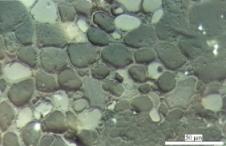
Textinite with cell fillings and empty cavities. White light excitation. Oil immersion lense
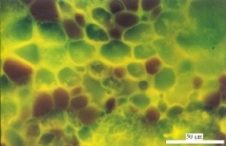
Textinite with cell fillings and empty cavities. Blue light excitation. Oil immersion lense
The Peat-Petrography Working Group was established in 2003 (Utrecht) and the aim of this WG is:
a. to bring together petrographers that deal with the petrological features of peat, but also scientists from other disciplines that have an interest in “peat science”,
b. to examine the applicability of the existent maceral terminology,
c. to assess/evaluate the necessity of a nomenclature scheme for the micropetrographic constituents of peat, and to which directions this scheme would be feasible to apply for.
Some preliminary directions can include:
• coal science (i.e. as maceral precursors)
• soil science (i.e. considering peat as organic-rich soil – histosols)
• organic-rich sediments science (i.e. dispersed organic matter)
• material science (i.e. applications in industry, environment protection etc.)
• botanic – plant science (i.e. phytogenic approach)
d. to propose a terminology that will accomplish the specifications for a comprehensive description of peat microscopic constituents.
Objectives
Overview, Objective & Methods
Up to now, 4 exercises have been conducted;
In 2004 and 2005, files containing photomicrographs from peat polished blocks, prepared from topogenous Greek and ombrogenous Finish mires, have been distributed, and the participants had to identify and comment on the particles featured in each image. The results were presented in the ICCP Meetings of Budapest and Patras, respectively.
In 2006 and 2007 exercises, polished blocks of intact peat from the Philippi and Nissi peatlands in Greece, have been circulated and the participants were asked to provide qualitative and quantitative characterization of the various constituents along with photomicrographs. The exercise lasted for 2 years and the replies were grouped and presented in 2007 in Victoria.
For 2008 the photographic material obtained from the peat-blocks that were previously provided by the members has been grouped mostly at maceral level. A file with images from the identified macerals was distributed and the participants had to comment on the images. The results were presented in Oviedo Meeting.
A draft classification of Peat macerals was discussed during the 64th ICCP Meeting in Beijing and at this stage the final report is prepared.
Activities
See all news for this working group: https://www.iccop.org/tag/peat-petrography/
Coal Bed Methane-CO2 Sequestration
| August 29, 2012 | Filled under Com II |
|
If you are interested in participating in the CBM-CO2 working group, please contact convener Lila Gurba at l.gurba@unsw.edu.au.
Objectives
The WG was created in Porto (1998) based on a proposal by Paul Lyons (U.S. Geological Survey) with the aim of identifying possible contributions of organic petrology to coalbed methane studies. At the 2001 Copenhagen meeting Lila Gurba became co-convener to look after petrographic aspects and application of coal petrology in CBM exploration. In 2003 the scope was enlarged to include applications to CO2 sequestration.
At the 1999 meeting in Bucharest, past convener Peter Crosdale proposed isotherm standardization as a first step in gas adsorption studies and later (2000, Rio de Janeiro) presented preliminary data from three laboratories on two coals. In ensuing years the focus of the WG was on determining a common procedure and protocol to measure gas adsorption capacities. Some results were presented at the 2007 ICCP Meeting in Victoria, Canada.
Activities
2019 Activities
- ICCP Meeting, The Hague – Presentation of summary of activities
- Minutes the Commission II – ICCP News No. 75, p. 14, December 2019
2020 Activities
- No progress has been reported
2021 Activities
- ICCP Meeting, Prague – Presentation of summary of activities
- Minutes the Commission II – ICCP News No. 75, p. 14, December 2019
2022 Activities
- No progress has been reported
Shale Gas Studies
| August 19, 2012 | Filled under Com II |
|
Background
Shale gas currently is a hot topic among exploration activities in USA, Poland, Australia, and other countries; however, shale gas explorationists are facing tremendous challenges:
- Despite its geographic abundance and enormous production potential, gas shale presents a number of challenges – ranging from the lack of an agreed-upon definition of what, exactly, comprises shale to uncertainties in thermal maturity assessment including minimum and maximum limits for gas generation and an optimum range for gas generation.
- Reliable interpretations of thermal maturity indicators provide critical data needed for resource estimates in thermogenic shale gas reservoirs. As noted by Jarvie et al. (2011), an understanding of gas preservation and reservoir alteration at high maturity remains poorly understood by industry and scientists alike.
- The terminology is confused; there is no common definition for the term ‘shale gas’; there is an absence of uniform guidelines; individual classifications used by industry are inconsistent. A more consistent definition of ‘shale gas’ would require a thoughtful effort at consensus within the sedimentary, petroleum geology, and organic petrology community.
- There is also inconsistent terminology used by industry to describe organic and inorganic components in ‘shale gas’.
Deliverables
- Regular updates presented at the ICCP meetings and disseminated through the ICCP website and ICCP Newsletter.
- ICCP Shale Gas Handbook.
- Results of a Round Robin Exercise on calibration of various thermal maturation indicators in a vertical sequence over a wide range of maturity.
Objectives
As announced in ICCP News No 51, a new working group on Shale Gas Studies was established within Commission II at the ICCP Meeting in Belgrade in 2010. The objectives of the working group are:
- To monitor and provide updates relating to organic petrology applications in shale gas exploration and development, and;
- To deliver a Shale Gas Handbook with the aim to establish uniform terminologies, and drawing on the organic petrology expertise of the ICCP members, to provide guidelines for the use and limitations of various thermal indices in the assessment of thermal maturity of shale gas reservoirs, and origin of hydrocarbons in these rocks. Questions about thermal maturity, organic matter content and shale composition have become increasingly important to geologists working the new shale-gas plays.
- Conduct a Round Robin exercise to calibrate various thermal indicators and investigate factors controlling thermal maturity assessment in a vertical section.
Activities
Activities 2012-2013
As discussed at the 64th ICCP meeting in Beijing, China, 2012-2013 activities of the Shale Gas Studies WG will include:
- Complete editorial group for ICCP Shale Gas Handbook:
- Table of Contents to be circulated to the working group members and convenors of relevant ICCP Working Groups (such as Identification of Primary Vitrinite, Concentration of Organic Matter, Thermal Indices, and others).
- Literature review – ongoing and updated on a regular basis:
- A substantial bibliography already was donated to the working group by Brian Cardott (USA).
- Identify (priority) issues and problems as related to coal and organic petrology.
- Obtain samples for Round Robin exercise (in progress).
Interested persons should contact Dr Lila W. Gurba at L.Gurba@unsw.edu.au to work on aspects of the Handbook chapters as per their expertise and interest.
Activities 2010-2011
At the 63rd ICCP meeting in Porto in 2011, a preliminary structure and Table of Contents for the Organic Petrology Shale Gas Handbook was presented by the Convenor (ICCP News 54).
References
Jarvie, D., T. Hantschel, T., Wygrala, B.P., 2011. Geochemistry, maturation, and petroleum system modelling related to shale gas resource evaluation. Society for Organic Petrology Short Course Notes, Halifax, NS, Canada, July 31, 2011, unpaginated.
Time Frame:
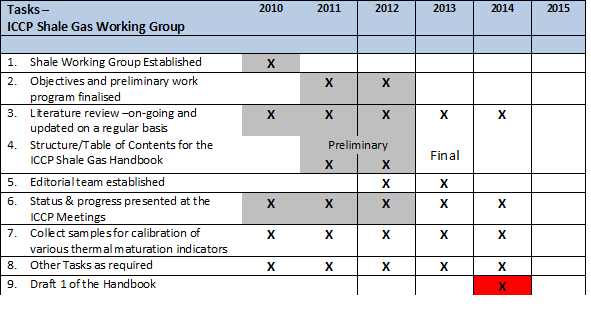
- Timetable of the Shale Fas Studies WG