
Igneous Intrusions in Coal Seams and Shales Working Group
| June 22, 2026 | Filled under Com II |
|
established 2013 Patras, Greece
Conveners
Members
Dr. Ferian Anggara
Dr. Mintui Cui
Dr. Tengwei Gao
Dr. Zhanming Guo
Dr. Yangyang Huang
Dr. Wu Li
Dr. Haojie Lian
Dr. Yu Liu
Dr. Chao Liu
Dr. Qinyuan Qu
Dr. Qianlong Xiao
Dr. Yunpeng Zhu
Objectives:
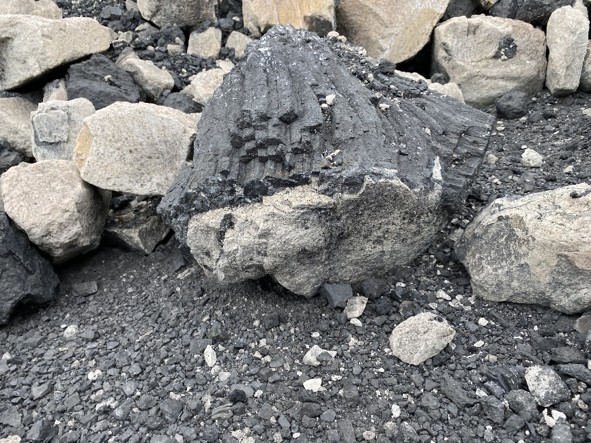
Columnar jointing in coal developed in contact with igneous intrusions, Moranbah Coal Measures, Bowen Basin, Queensland, Australia.
The working group Igneous intrusions in coal seams and shales WG was established in 2022 during the 73rd ICCP meeting in India. One of its the main objectives is to investigate the petrographic changes in organic, coaly, and associated mineral matter caused by contact metamorphism. Complementary analysis – including where possible, Raman spectroscopy, micro-FTIR, RockEval, GC-MS, biomarkers, SEM/EDS, XRD, XRF and proximate analysis (ash, volatile matter, and moisture contents) – will be used to help understand the chemical and structural transformations induced by temperature and pressure conditions associated with igneous intrusions.
Overview:
As the name implies, igneous rocks are formed through the cooling and solidification of molten rock, either magma or lava. They can be classified into two broad categories: intrusive and extrusive. Intrusive igneous rocks form when magma is trapped underground and cools slowly over thousands or millions of years, forming rocks such as granite, gabbro, peridotite, and diorite. Extrusive igneous rocks form when magma erupts onto the Earth’s surface as lava and cools rapidly, forming rocks such as basalt, rhyolite, obsidian and pumice.
Many of the igneous bodies observed in coal mines are relatively small-scaled localised intrusions rather than massive plutons. These localised intrusive igneous bodies include dikes, sills, laccoliths, phacoliths, chonoliths, and volcanic necks. Common igneous rocks associated with these intrusions include dolerite/diabase, porphyry, microgranite, and lamprophyre. These are often described as hypabyssal, or subvolcanic, rocks, which solidify at shallow depths in the Earth’s crust, typically less than 2 km deep.
Igneous emplacement can have a major impact on coal mining. Intrusions can reduce coal resources and change the physical and chemical properties of the coal surrounding the igneous body. The extent of thermal alteration depends on the size, thickness, type, shape of the intrusion, fluid flow, water saturation in the surrounding host sedimentary rocks, thermal diffusivities of the intrusive and the host rocks, heating duration, and the rank of the coal at the time of emplacement. Most thermally altered coals are treated as waste, leading to increased production costs, reduced resources, and waste management challenges for the coal industry.
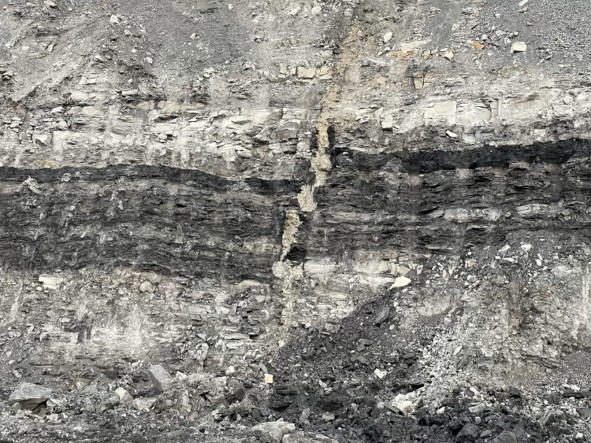
Igneous dike cutting through a coal seam and underlying and overlying sediments, with displacement along a normal fault, Bowen Basin, Queensland, Australia. Courtesy of Marnus van Lille.
Petrographically, several signals of thermal alteration caused by igneous intrusions in coal seams can be recognised. The first sign is usually an increase coal rank and in vitrinite reflectance [VRr (%)] and in many cases related anisotropy. Even when no other evidence is clear, an increase in reflectance relative to the background coal indicates that the coal has been affected by abnormal heating. As we approach the contact zone, the degree of alteration becomes more severe. Devolatilisation pores, mesophase spheres, mosaic textures, and microfracturing may develop among others, and new particles, such as pyrolytic carbon and coal tar may form. In extreme cases, the coal may be transformed into natural coke or graphite particles.
Overall, the degree of thermal alteration of coal is related to the distance from the contact zone, while the intensity of alteration depends on the factors mentioned above.
The rank of the coal at the time of intrusion is particularly relevant to coal geologists because different coal petrographic features may develop. For example, background coals within the coking coal range, approximately 0.8–1.8% Rr, may form natural coke in contact with the igneous body where temperatures allow the coal to become fluid and then solidify as natural coke. However, very low-rank coals, such as lignites, tend to produce anthracitic material rather than natural coke. The same applies to coals in the anthracite range, as they generally do not melt.
Thus, the objective of this Working Group is to investigate the petrographic changes in coal and other organic matter, such as organic matter in shales, promoted by contact metamorphism. Thermal alteration in modern geothermal environments will also be taken into consideration.
To carry out the coal petrographic characterisation of thermally coally organic matter, this Working Group will organise a series of Round Robin exercises using photomicrographs distributed to participants. Given the range of factors that can contribute to variability, it is important to capture different coal ranks in different geological contexts.
Associated with the petrographic work, other analyses will be considered where possible, including Raman spectroscopy, micro-FTIR, Rock-Eval, GC-MS, biomarkers, SEM/EDS, XRD, XRF, ash yield, volatile matter, and moisture content. This set of analyses will help us understand the chemical and structural transformations undergone by organic matter, coaly matter, and mineral matter affected by the temperature and pressure fields associated with igneous bodies.
This Working Group will also investigate the impact of igneous emplacement at the megascopic scale, including deformation features such as folding and fracturing, columnar jointing, and other visible alterations.
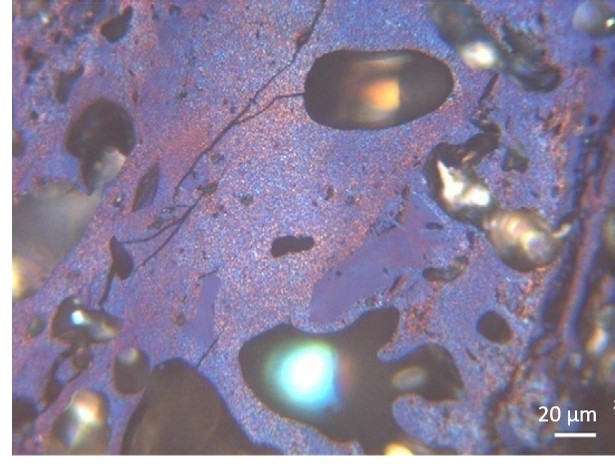
Petrographic characteristics of thermally altered coal developing a fine mosaic texture. Springfield (No. 5) Coal, Illinois Basin (Rahman and Rimmer, 2014).
Currently, Susan Rimmer, co-convener of this Working Group, is finalising a review paper on this topic, to be submitted in 2026. This Working Group will build on that work by developing an Atlas on the coal and organic petrographic characteristics of thermally altered coals and shales, including alteration features and newly formed particles.
Why should you participate?
If you work with coal, organic-rich shales, contact metamorphism, natural coke, or heat-affected organic matter, this Working Group is directly relevant to your work. Igneous intrusions can strongly alter coal and dispersed organic matter, but many of the resulting features are still difficult to classify consistently. By participating in the Round Robin exercises, you help identify where petrographers agree, where uncertainty remains, and what needs to be clarified.
Your contribution will help build a more consistent petrographic framework and support the development of an ICCP Atlas on thermally altered coals and shales. This is an opportunity to contribute to a practical reference that will be useful for research, industry, training, and future ICCP work.
Activities:
2023 Activities
ICCP Meeting, Patras – Presentation of summary of activities;
Minutes the Commission II– ICCP News No. 87, p. 22, December 2023
2024 Activities
Preparation of the Round Robin Exercise;
ICCP Meeting, Oviedo – Presentation of summary of activities;
Minutes the Commission II– ICCP News No. 90, p. 21, December 2024
2025 Activities
Preparation of the 2025 Round Robin Exercise;
- HAC WG_RR01_June 2025 excel document;
- Letter to the participants and Classification scheme.pdf document;
- Igneous Intrusions WG_2025 round.pdf document
ICCP Meeting, Beijing – Presentation of summary of activities;
Report on the results of the 2025 Round Robin Exercise.
Minutes the Commission II– ICCP News No. 93, p. , December 2025