
Blog Archives
Coal Blends Accreditation Program
| January 29, 2013 | Filled under Com III |
|
The Coal Blends Working Group is concerned with the investigation of coal blends using microscopic methods. This Working Group was established during the 47th ICCP Meeting at Krakow, Poland, in 1995. Prof. Dr. Alan Davis was the first Convenor (1996 and 1997) followed by Dr. Isabel Suárez-Ruiz from 1998 till 2019. Since 2020 Dr. Malgorzata Wojtaszek-Kalaitzidi is the convenor. The main reasons for which this group was created were the growing use of blends in international trade and the recognition by ISO?s Ad Hoc Committee on Coal Classification that chemical methods cannot be applied to coal mixtures. For many years, some coal laboratories have estimated coal blend compositions using microscopic methods but there is no established procedure for this type of analysis. Thus, to find a petrographic method which will serve as a standard procedure for characterizing all types of coal blends is a subject of great interest at international level in the field of commercial coals.
The Coal Blends Accreditation program WG was created in 2004 (Budapest) to accredit coal petrographers in coal blend analysis by using microscopic analysis.
The participants of the accreditation programme are requested to determine:
- The number of coals in the blend
- The overall vitrinite reflectance (random) of the coal blend
- The vitrinite reflectance (random) of each coal in the blend
- The overall maceral composition (m.m.f.) in terms of vitrinite content
- The maceral composition of each coal in the blend
- The proportion of each coal in the blend
The analyses should be performed following the ISO standards for analysis of coals and the methods developed by the Coal Blends Working Group.
Objectives
The general objective of the Coal Blends Working Group is to investigate the efficiency of microscopic methods for estimating the composition of coal blends.
Since 1996 several ring analyses on different coal blends with variable petrographic characteristics related to composition and reflectance values have been carried out by the interested participants. Each coal blend was specifically prepared for the corresponding analysis and the proportions of the coals used to make up the blends were different each year. At the same time the degree of difficulty of the coal blend to be analysed has increased since 1996.
In all cases, the information required for the petrographic analysis of the coal blends was:
- the proportions of coal components in the coal blend.
- the mean random vitrinite reflectances of the coals that made up the coal blend.
Additional information related with the petrographic composition of each coal in the blend was also requested.
The current proposed methodology for analysing coal blends is to use:
- Conventional methods: point-counting analysis and manual reflectance determinations,
- Automated analysis which tries to obtain data related to coal blend composition and the rank of the different component coals.
Activities
Current activities
The database program was developed by Paddy Ranasinghe and supported by Alan Cook and it is currently being tested at Oviedo, Spain. The CBAP has 13 available single coals (two of them need coal cleaning, another one is duplicated). In November 2006, two coal blend samples will be prepared and sent out to the participants as un-mounted samples, ground to 1 mm stage. The preparation and polishing of the pellets will be carried out by the participants. The instructions for carrying out the exercise are being prepared and will be sent out to the participants with the coal blend samples. The program has 17 potential participants.

Microphotographs of a binary coal blend in reflected white light, oil immersion (32x); 1 of 2.

Microphotographs of a binary coal blend in reflected white light, oil immersion (32x); 2 of 2.
Summary of main results from the different tests:
Current activities for 2000 and future work:
- 2000.- To solve the problems detected, it was decided during the last ICCP Meeting at Bucharest that a new binary blend made up of two coals with all their known petrographic characteristics should be studied. Thus, samples of a coal blend composed of two Tertiary coals were distributed among the participants. The results will be compiled and then discussed during the next 52nd ICCP Meeting in Rio de Janeiro (Brazil).
- To summarize all the results obtained from binary coal blends and to conclude which petrographic methodology is more appropriate for investigating these blends. Application of the selected methodology on coal blends made up of two anthracitic coals.
- To apply microscopic methods to the investigation of more complex blends (blends of three or more coals, blends with additives, etc…).
- Additional work: to contribute with the results and experience obtained to writing up and up-dating the “Sheets on Coal Blend Analysis”
1999
Objective.- To analyse commercial coal blends using the petrographic used in the previous trials.
Type of coal blends.- Two different but complex commercial blends, with coals of different rank, inertinite content and low mineral matter.
Main conclusions:
- In general, acceptable identification of groups of component coals and random reflectance determinations.
- Composition of coal blends: Results from point-counting analysis were more accurate than those from reflectance determinations but the standard deviation is higher in the first case.
- No available data from automated analysis.
- Comparing the accuracy of results related to the blend composition from all tests, the best results were obtained in the 1999 trial probably due to the high number of points counted and measured.
1998
Objective.- To develop a mean of pro-rating pure inertinite particles in inertinite-rich binary blends.
Type of coal blend.- Binary, with coals of different rank, inertinite content and low mineral matter.
Main conclusions:
- Encouraging results related to the identification of coal components and mean random reflectance determinations. Greatest accuracy from automated determinations.
- Composition of coal blend: best results from point-counting analysis and when the blend composition is corrected by application of the established method for pro-rating the “non-assignable inertinite particles” between the components of the coal blend.
1997
Objective.- To investigate a blend in which a coal is inertinite-rich using the same methods as in the previous year.
Type of coal blend.- Binary, without mineral matter and fine particles and with an inertinite-rich coal.
Main conclusions:
- Satisfactory identification of coal components and mean random reflectance determinations in both manual and automated analysis.
- Composition of coal blend: differences between the actual composition of the blend and the composition calculated from results of reflectance determinations and point-counting analysis because of the high inertinite content of one of the coals. However, better results were obtained from point counting determinations and similar data using automated analysis systems.
- Necessary: To pro-rate isolated particles of inertinite between components of the blend.
1996
Type of coal blend.- Binary, simple, without mineral matter and fine particles, very different rank of participant coals.
Main conclusions:
- Satisfactory identification of coal components and mean random reflectance determinations.
- Composition of coal blend: better results from point-counting analysis because of the high number of determinations.
- Similar results in both manual and automated analysis.
Combustion
| January 29, 2013 | Filled under Com III |
|
Aims of the Working Group
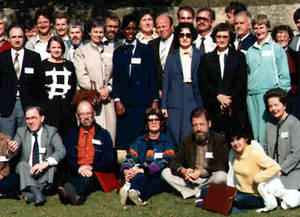
Some of the participants at the Doncaster Meeting, where the WG was created.
The wide possibilities foreseen from the application of petrographic techniques to the study of chars encouraged the formation of a new Working Group within Commission III (industrial applications) of the ICCP, at the Doncaster meeting in1986 (see photo). Margaretha Bengtsson was elected as the convenor of this new working group. The objectives of this Working Group are:
- To investigate the changes undergone by coals and their maceral components during pyrolysis and combustion
- To obtain char characterisation data relevant to combustion, and,
- as a combination of these, to identify the most and least-likely-to-burn fractions of coal.
- To develop analytical procedures (char classification systems) for the petrographic characterisation of pyrolysis and combustion chars.
Fields of interest
The combustion of pulverised (typically > 70% below 75 µm) coal particles takes place in two well defined steps:
- Thermal decomposition (pyrolysis) of the solid, which involves the release of volatile species and leads to the formation of a carbonaceous solid residue called pyrolysis char
- Gasification (oxidation) of this solid residue with the oxygen present in the boiler. During the first process, which takes about 50-100 ms, the coal particles melt to varying extents and the evolving volatiles form a network of pores in the molten carbonaceous groundmass, which remain in the char particles after resolidification. As regards the gasification step (a few seconds), the efficiency of the process will largely depend on the ability of the oxygen to diffuse to the inner (pores) and outer surfaces of the newly formed char.The observation of polished blocks of char samples under the optical microscope can offer invaluable information about the above-mentioned processes. Thus, properties such as the porosity and pore size distribution within the char particles, the breadth of the char walls, or the particle size and shape (related with the swelling behaviour of the coal) can be estimated by a simple petrographic assessment. The optical texture (isotropy/anisotropy) of the carbonaceous matter, as seen by the optical microscope under crossed polars, gives information about the surface concentration of active carbons (those through which the reaction with oxygen is thought to proceed), and therefore about the intrinsic reactivity of the char material, i.e., without regards to possible diffusional constraints.Finally, the presence of unburnt material in the cyclones at the outlet of the boiler, an undesirable but quite frequent event during normal operation of power stations, is also a matter of research for the petrographer. Thus, the microscopic examination of partly combusted chars can be of great help in identifying the parent char material and, from this, the specific coal and/or coal component which did not burn away efficiently. This is of great practical importance, as the use of complex coal blends as feedstock in power plants makes it difficult to ascribe the unburnt material to one or another of the various components.
Activities
Activities of the Working Group
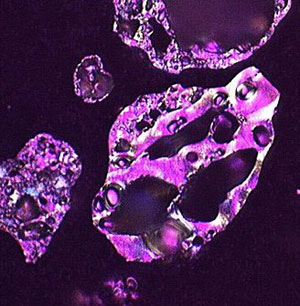
Severely altered anisotropic char particle (CRASSINETWORK)
The activities of the Working Group since its creation were aimed at the onset of a unified criterion among members for the classification of char particles. To achieve this, Round Robin exercises were performed where participants were asked to analyse polished blocks of char samples, identifying char particles selected on a point-counting basis, and classifying them according to a proposed classification scheme. The results obtained from each exercise were discussed in the next meeting, from which a refined classification scheme arose, to be then used in the next exercise. This work was mainly carried out under the convenorship of J.G.Bailey (from 1990, Wollongong Meeting, to 1996), who established the basis of the Char Classification System being currently used by the Working Group. This is (revised after the Bucharest meeting, 1999) as follows:
| CHAR TYPE | DESCRIPTION |
| Tenuisphere | Spherical to angular, porosity >80%, >50% of wall area <3µm. >75% fused material |
| Crassisphere | Spherical to angular, porosity >60%, >50% of wall area >3µm. >75% fused material |
| Tenuinetwork | Internal network structure, porosity >70%, >50% of wall area <3µm. >75% fused material |
| Crassinetwork | Internal network structure, porosity 40-70%. >50% of wall area >3µm. >75% fused material |
| Mixed porous | Char with 25-75 % unfused material. Porosity >60% |
| Mixed dense | Char with 25-75 % unfused material. Porosity 40-60% |
| Inertoid | Dense, porosity 5-40%, >50% of wall area >3µm. Fused or unfused |
| Fusinoid/Solid | Inherited cellular fusinite structure or solid particle with <5% porosity. > 75% unfused |
| Mineroid | Particle with >50% inorganic matter. |
J.G.Bailey relinquished the convenorship after the Herleen meeting (1996) and the commitment was passed on to Edward Lester and Diego Alvarez, the current convenors of the Working Group.
The last exercises carried out consisted of
1997: A char collected after a short residence time in the boiler and a combustion residue from the same run had to be compared in this exercise. Furthermore, the combustion residue was concentrated by two different methods: sieving and discarding the < 75µm fraction, supposed to be mainly composed of inorganic constituents, and acid digestion of the inorganic fraction. The analysis of the three samples thus obtained revealed that the two methods used for the beneficiation of the flyash were equally valid, the former having the advantage of a saving of time and laboratory work. The data reported by participants showed fairly good repeatability’s, but the reproducibility was still very poor. As a consequence, no conclusive results were obtained from the comparison of the pyrolysis char and either of the combustion chars
1998: The use of an improved classification scheme led to much better reproducibility’s in the analysis of a medium rank, high inertinite coal char obtained at lab scale.
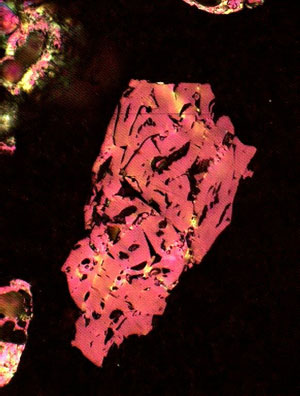
Inertinite-derived isotropic char particle, virtually unaltered during pyrolysis (FUSINOID)
1999: The same sample as in the previous years exercise was analysed following a more comprehensive classification scheme. The reproducibility was not much better than in the 1998 exercise, but this can even be considered as a successful result, given the additional complexity of the scheme. This year, for the first time, a CD containing images of selected char particle cross-sections was also distributed to participants. The images consisted in some examples of each of the char structural types considered in the classification system, plus 140 images from char structures taken from seven coals of different ranks and maceral compositions, which participants had to classify according to their own criteria. The results showed that the reproducibility was exceptionally good, much better than ever seen before in a Round Robin exercise of this working group. This is a proof that the major source of disagreement comes from differences in the operating conditions of the microscopes (illumination, magnification, use of retarding plate, etc.) used by participants, rather than a lack of precision in the definition of the various char types or an inability of participants for estimating the morphological parameters required in the application of the classification system.
In the Bucharest meeting (1999), the working group decided to temporarily abandon the manual analyses and concentrate the effort in the generation of a large graphic database containing all those structures which had been classified as a given char type by at least 75% of the participants in a CD Round Robin Exercise.
Round Robin exercises on combustion char samples and CD-photos have been conducted.
The WG has had excellent participation with 18-20 people for each exercise.
Reports and materials available:Convener’s 2002 Presentation (in Power Point).E. Lester gave a recap of the char atlas and the results of previous analyses. The status of the char atlas was presented (2003, The Nederland, Utrecht).
Minutes of the 55th Meeting of the ICCP, Commission III, ICCP News, 30, pp.28, (2003).
Future activities:
The next exercise will be CD-based and it will focus on linking fly-ash chars to the parent coal.
Coke Petrography
| January 29, 2013 | Filled under Com III, Workinggroups |
|
Objectives
To establish a classification of coke textures which is reproducible and which can predict coke technological properties.
Activities
Round Robin exercises have been conducted by asking participants to identify specific points in colour photographs in order to the scheme that was previously agreed upon. The activities involved different levels:
- distinction between isotropic or not;
- distinction between fusible and infusible material;
- identification of the morphological differences (anisotropy domain) shape, size, origin.
In 2004 the convenor summarised the activities of the WG, in particular what has previously been done to establish a coke classification system and where are the difficulties. The convenor then gave a presentation of the results of automated measurements of coke texture carried out at ThyssenKrupp Stahl.
Analysis and discussion of 24 colour slides of coke microstructure has taken place during 2006 in order to better evaluate coke textures and nomenclature. This co-operation is a necessary continuation of the difficult problems regarding coke texture from coal blends, which may form the basis of future round robin exercises.
Further activities could be to analyse the coke texture in interdependence to coking technology and parameter regarding coke quality.
2018 Round Robin Exercise.
A new exercise has been released for 2018. Please contact Dr. Malgorzata Wojtaszek (mwojtaszek@ichpw.pl) for more information, as well as registration requirements for downloading all the files.
The Final Report of the 2018 Exercise is available upon log in.
2019 Round Robin Exercise
The Second Round of Proficiency Testing concerning Coke Petrography analysis, STARTED!
Members who are interested please download the initial instructions.
In this Round participants will measure minimum and maximum reflectance and optical textures according to the instructions they will receive with the samples.
Samples will be sent in form of polished blocks by the end of February.
For registering please visit EBOU platform and log in selecting P/1/2019-B in the SELECT Proficiency Test menu and apply for samples by clicking “Sample order” in “Application for Participation” tab.
For New participants please follow the instructions.
NEW 2021 Round Robin Exercise
Environmental Application of Organic Petrology
| January 29, 2013 | Filled under Com III |
|
The Environmental Application of Organic Petrology Working Group was formed at the 45th Annual Meeting of the ICCP held at Chania, Crete, Greece in 1993.
Objectives
Front Page of the Atlas of Anthropogenic Particles
The original objectives of the Working Group under A. Depers & J. Bailey guidance were:
- to review case studies where organic petrology has helped to solve environmental problems;
- to compile information on methods and instrumentation used in case studies, with the ultimate aim of producing a standard procedures document; and
- to assemble a bibliography of published papers, unpublished open file reports, abstracts from symposia, and unpublished data into a “user-friendly” and accessible format (for example, as an ASCII computer file or converted to a commonly used word processor language).
Additional objectives developed between 2000-2006 under M. Mastalerz guidance were as follows:
- to develop a classification scheme of anthropogenic matter that could be helpful in petrographic characterization of different types of systems that are either produced or affected by industrial/human activity (fly ash, soil/sediment, water, air); and
- to prepare a digital atlas of anthropogenic particles from different sources. The main purposes of this atlas are to: a) help identification of anthropogenic particles under microscope, and b) to help identify the source of the anthropogenic particles.
The Atlas was completed in 2006 and is available for purchase from ICCP.
Following publication of the Atlas of Anthropogenic Particles in 2006 the proposed activities of the WG were:
- It is essential to test the applicability of the Atlas of Anthropogenic Particles by examining more samples of an anthropogenic nature. The new editions of the Atlas may include future input of information in the current body of work as the results of exchange and classification of the available data by participating associates.
- Organic carbon forms a significant portion in the global cycling of carbon. Furthermore, recent findings suggest that organic matter play an important role in distribution and accumulation of hazardous substances such as mercury, other heavy metals, and Persistent Organic Pollutants (POPs). Therefore, there is an increasing demand for studying the organic matter in recent surface deposits, riverine systems, lacustrine and marine environment. In conjunction with various geochemical techniques, the optical characterizations of the recent organic matter will play an important role in documenting and source apportionment of organic carbon in these systems.
Activities
Reports and materials available:
- White Paper. Edited and compiled by A.M. Depers and J. G. Bailey in 1994 (ICCP archival material, please contact Dr. Deolinda Flores)
- Bibliography on Environmental Applications of Organic Petrology. Compiled by J.C. Crelling, A.M. Depers, J.C. Hower, M. Mastalerz, M. Glikson, and P.K. Mukhopadhyay in 2001 (ICCP archival material, please contact Dr. Deolinda Flores)
- Atlas of Anthropogenic particles. The main purpose of this atlas is to help to identify and describe anthropogenic particles from any environment or site of deposition and determine their source. To serve this purpose, images are grouped into two sections:1) anthropogenic particles classified by source, including particles from well-defined sources (for example, power plants, coke plants)
2) anthropogenic particles classified by the site of their occurrence (for example, soil, air, water).The atlas includes 543 images compiled from 2002 to 2005. Most images were taken under a reflected light microscope (both with dry objective and in oil), although some images are included from scanning electron microscopes (SEM) and transmission electron microscopes (TEM). Only images from well-defined sources are included in the atlas, but the details of each description vary, depending upon the level of confidentiality related to the source.
At the 2008 ICCP Annual Meeting the convener reviewed the activities carried out over the years and made some proposals for future work. Possible actions for the future are:
- testing the applicability of the classification to study environmental samples, focusing on the study of unconsolidated sediments
- preparing a special volume to be published in a peer-reviewed journal about the various applications of organic petrology in environmental issues,
- adding to the atlas some guidelines to help to classify the particles.
The Environmental Applications of Organic Petrology working group was closed at the 2011 ICCP meeting in Porto. Hamed Sanei reviewed the working group activities at that time and made some specific suggestions for future work:
- to broaden the material in the Atlas of Anthropogenic Particles to include more international localities.
- to summarize in table format recently published environmental studies which included organic petrology applications.
- to host a dynamic database (summary table of environmental studies including organic petrology applications) from the working group webpage.
The Environmental Applications of Organic Petrology working group is now closed. Potential new conveners or working group members interested in reopening the activities of the WG are encouraged to contact the Commission II Chair or Secretary.
ICCP Training Activities
| January 29, 2013 | Filled under Com I, Service |
|
Introduction
ICCP provides training courses on Organic Petrology subjects. For more information please visit Courses
Reflectance Standard Checking
| January 29, 2013 | Filled under Com I, Service |
|
Introduction
The service to check standards against the ICCP Reflectance Standard continues to be available from Richard Pearson (50€ for non-members and free for ICCP members) and from Evelyn Bieg (only for ICCP members).
Single Coal Accreditation Programme
| January 29, 2013 | Filled under Com I, Service |
|
Introduction
Single Coal Accreditation Program (SCAP) for both maceral group and vitrinite random reflectance analyses. In this program the ability of an analyst to identify and quantify the maceral groups and to identify and measure the vitrinite reflectance of a coal sample according to ISO standards is tested.
For more information please visit: Accreditation in Petrographic Analysis
Raman Spectroscopy
| January 29, 2013 | Filled under Com I, Editorial Group |
|
Introduction
The Editorial Group is preparing the Raman Spectroscopy Chapter for the ICCP Handbook focusing on the application of Raman Spectroscopy on coal science.
New Methodologies & Techniques in Organic Petrology Editorial Group
| January 29, 2013 | Filled under Com I, Editorial Group |
|
Introduction
The scope of the New Methodologies & Techniques in Organic Petrology Editorial Group is to prepare the “Handbook of Instrumental Techniques Applied in Coal and Organic Petrology- Electron Microprobe”
The Handbook is structured in two Parts:
Part I: Instrument (Capabilities, limitations, development of analytical protocols, standards etc.)
Part II. Coal macerals and source rocks studies using EMA
References