
Blog Archives
Identification of Dispersed Organic Matter
| April 5, 2015 | Filled under Com II |
|
Objectives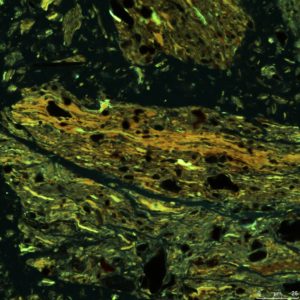
The Identification of Dispersed Organic matter working group (IDOM WG) was created in Budapest (2004) upon revision of the activities of the former Isolation of Sedimentary Organic Matter WG (1988-1998). The focus of this WG is to test the applicability of the existing nomenclature of dispersed organic matter classified in accordance to the ICCP-TSOP Classification System (2004). To address difficulties arising from the use of different nomenclatures within the Isolation of Sedimentary Organic Matter WG, the liptinite maceral group was chosen to test the identification of alginite and bituminite in sedimentary rocks.
The activities of the WG are comprised of round robin exercises with the aim of identification of dispersed organic matter (bituminite, alginite, etc.) on digital images by application of ICCP definitions enclosed in the Handbook of Coal Petrography, 3rd supplement to the 2nd edition (1993).
Activities
2005 Activities:
- Compilation of graphic material;
- Scanning of graphic material from former Round Robin Exercises by M. Mastalerz;
- Preparation of an initial Round Robin Exercise adopting the ICCP-TSOP Classification System to kerogen identification;
- ICCP Meeting, Patras – Presentation of summary of activities.
2006 Activities:
- Acquisition of additional micrographs from L. Stasiuk, Canada;
- Circulation of the 1st Round Robin Exercise adopting the ICCP-TSOP Classification System to kerogen identification;
- Based on: 11 micrographs of kerogen concentrates in fluorescent light
- Participants: 17
- Objectives: 1) to identify the marked particles, 2) to indicate your level of confidence in identification, and 3) to depict characteristics decisive and in favour of the identified particle
- 1st 2006 Round Robin Exercise text
- 1st 2006 Round Robin Exercise PowerPoint
- 1st 2006 Round Robin Exercise table for comments
- ICCP-TSOP Classification of DOM
- ICCP Meeting, Bandung � Presentation of activities summary by A. Gomez Borrego.
2007 Activities:
- Report on results of the 1st 2006 Round Robin Exercise;
- ICCP Meeting, Victoria – Presentation of summary of activities by A. Gomez Borrego;
- Search for suitable photomicrographs of alginite, amorphinite/bituminite in whole rock examples.
2008 Activities:
- ICCP Meeting, Oviedo – Presentation of summary of activities;
- Preparation of the 2nd Round Robin Exercise adopting the ICCP-TSOP Classification System to whole rock identification.
2009 Activities:
- Circulation of the 2nd Round Robin Exercise adopting the ICCP-TSOP Classification System to whole rock identification;
- Based on: 92 micrographs of whole rock samples in white and fluorescent light
- Participants: 16
- Objectives: 1) to distinguish alginite and bituminite in whole rock samples, 2) to mark problematic positions for the recognition of alginite and bituminite macerals or their types, 3) to state a reason for poor recognition of alginite and bituminite macerals or their types in an assessment sheet
- 2nd 2009 Round Robin Exercise text
- 2nd 2009 Round Robin Exercise PowerPoint
- 2nd 2009 Round Robin Exercise table for comments
- 2nd 2009 Round Robin Exercise automated word document
- 2nd 2009 Round Robin Exercise bituminite definitions: Taylor, Stach, ICCP
- 2nd 2009 Round Robin Exercise alginite definitions: Taylor
- ICCP Meeting, Gramado – Presentation of summary of activities.
2010 Activities:
- Report on the results of the 2nd 2009 Round Robin Exercise;
- PowerPoint on the results of the 2nd 2009 Round Robin Exercise;
- ICCP Meeting, Belgrade – Presentation of summary of activities.
2011 Activities
- Contribution to the Alginite Sheets;
- Contribution to the Liptinite Sheets;
- ICCP Meeting, Porto – Presentation of summary of activities;
- Circulation of the 3rd Round Robin Exercise adopting the ICCP-TSOP Classification System to whole rock identification:
- Based on: 72 micrographs of whole rock samples in white and fluorescent light
- Participants: 9
- Objectives: 1) to distinguish alginite, bituminite in whole rock samples, 2) to mark problematic positions for the recognition of alginite and bituminite macerals or their types, and 3) to state a reason for the poor recognition of alginite and bituminite macerals or their types in an assessment sheet
- 3rd 2011 Round Robin Exercise text
- 3rd 2011 Round Robin Exercise automated word document
- Report on the results of the 3rd 2011 Round Robin Exercise
2012 Activities
- Preparation of extensive case scenarios of bituminite types at different rank ranges from one to three known world localities, giving detailed descriptions of physical and morphological properties;
- ICCP Meeting, Beijing – Presentation of summary of activities by Magdalena Misz-Kennan.
2013 Activities
- Accomplishment and presentation of a maturity series (Part I) with Posidonia Shale from the Hils area, Lower Saxony, Germany.
- ICCP Meeting, Sosnowiec – Presentation of summary of activities.
2014 Activities
- Accomplishment and presentation of a maturity series (Part II) with Posidonia Shale from the Hils area, Lower Saxony, Germany.
- ICCP Meeting, Kolkata – Presentation of summary of activities.
2015 Activities
- Preparation of 2016 IDOM WG round robin exercise on bituminite from Kimmeridge Clay Formation, Kimmeridge Bay, UK.
- ICCP Meeting, Potsdam – Presentation of summary of activities.
2016 Activities
- Performance of 2016 IDOM WG round robin exercise on bituminite from Kimmeridge Clay Formation, Kimmeridge Bay, UK.
- Evaluation of 2016 IDOM WG round robin exercise on bituminite from Kimmeridge Clay Formation, Kimmeridge Bay, UK.
2017 Activities
- Report on the results of the 4th 2016 Round Robin Exercise
- Publication of 2006, 2009, and 2011 round robin exercises of the ICCP Identification of Dispersed Organic Matter Working Group
- ICCP Meeting, Bucharest– Presentation of summary of activities.
2018 Activities
- ICCP Meeting, Brisbane – No presentation of summary of activities.
- Preparation of 2018 IDOM WG round robin exercise on bituminite from Kimmeridge Clay Formation, Filey Bay, UK.
- Circulation of the 5th Round Robin Exercise adopting the ICCP-TSOP Classification System and ICCP Liptinite Classification to whole rock identification:
- ICCP_IDOM_Round_Robin_2018_Guideline.doc
- ASTM D7708-14 Standard.pdf
- Classification of Liptinite – ICCP System 1994.pdf
- Bituminite description sheet .docx
- Identification of alginite and bituminite in rocks.pdf
- Report on the results of the 5th 2018 Round Robin Exercise.pdf
2019 Activities
- Report on the results of the 6th 2018 Round Robin Exercise.
- ICCP Meeting, the Hague – Presentation of summary of activities.
- Preparation of 2019 IDOM WG round robin exercise on bituminite from Kimmeridge Clay Formation, North Sea, UK.
2020 Activities
- ICCP_IDOM_Round_Robin_2020_Guideline.doc
- ASTM D7708-14 Standard.pdf
- Classification of Liptinite – ICCP System 1994.pdf
- Bituminite description sheet.docx
2021 Activities
- ICCP Meeting, Prague – Presentation of summary of activities
- Minutes the Commission II– ICCP News No. 81, p. 11, December 2021
2022 Activities
- ICCP Meeting, New Delhi – Presentation of summary of activities
- Minutes the Commission II – ICCP News No. 84, p. 14, December 2022
- Report on the results of the 7th 2020 Round Robin Exercise
2023 Activities
- Preparation of 2023 IDOM WG round robin exercise on bituminite from Kimmeridge Clay Formation, North Sea, UK.
- ICCP Meeting, Patras – Presentation of summary of activities
2024 Activities
- Report on the results of the 8th 2023 Round Robin Exercise
- Preparation of manuscript of 2016, 2018, 2020 IDOM WG round robin exercises on bituminite from Kimmeridge Clay Formation
Classification of Dispersed Organic Matter ICCP-TSOP DOM Atlas
| April 5, 2015 | Filled under Com II |
|
This project is a joint effort of the International Committee for Coal and Organic Petrology (ICCP) and of The Society for Organic Petrology (TSOP). The Classification system was agreed to in 2003 and is a single system for different illumination modes. An Atlas is under preparation which illustrates the appearance of the different dispersed organic components under different illumination conditions and using different methods for sample mounting. Julito Reyes presented the status of DOM Atlas at the Meeting in Oviedo, 2008, on behalf of the Conveners. Carolyn Thompson-Rizer has taken the compilation work on the web site during this year for suggestions and improvements.
Objectives
The purpose of the Classification of Dispersed Organic Matter ICCP-TSOP DOM Atlas WG is to provide a reference atlas to illustrate the appearance of the different dispersed organic components under different illumination conditions and using different methods for sample mounting. The Working Group has been established in 2003 and is a joint effort of the International Committee for Coal and Organic Petrology (ICCP) and The Society for Organic Petrology (TSOP). The first version of the DOM Atlas was completed in September 2010. In 2018, a second version was sent to two independent reviewers (one from TSOP and the other from ICCP) for advice on the suitability of the content for wider circulation.
The Atlas represents a valuable and useful contribution to organic petrology and will provide an excellent resource both for educational purposes and to assist wider professional communication.
The Working Group on Classification of Dispersed Organic Matter ICCP-TSOP DOM Atlas will be open to all petrographers interested in providing photomicrographs to be included in the Atlas. Interested parties are encouraged to contact Paula Alexandra Gonçalves (paula.goncalves@fc.up.pt).
Activities
A preliminary example of the layout of the Atlas was presented at the Meeting in Victoria, 2007.
2015 Activities
ICCP Meeting, Potsdam – Presentation of summary of activities
Minutes the Commission II – ICCP News No. 63, p. 27, November 2015
2016 Activities
ICCP Meeting, Houston – Presentation of summary of activities
Minutes the Commission II – ICCP News No. 66, p. 16, December 2016
2017 Activities
ICCP Meeting, Bucharest – Presentation of summary of activities
Minutes the Commission II – ICCP News No. 69, p. 14, December 2017
2018 Activities
ICCP Meeting, Brisbane – Presentation of summary of activities
Minutes the Commission II – ICCP News No. 72, p. 8, December 2018
2019 Activities
ICCP Meeting, The Hague – No activities
2021 Activities
ICCP Meeting, Prague – No activities
2022 Activities
ICCP Meeting, New Delhi – No activities
Qualifying Vitrinite for DOM Reflectance Analysis
| April 5, 2015 | Filled under Com II |
|
Objectives
Front Page of the Training CD
The group was created in 1999 (Bucharest) to test and discuss a qualifying system for vitrinite particles in order to determine the quality of reflectance data.
Milestones
- The labelling system initially proposed by J. Koch (BGR, Hannover) was discussed, tested and modified to improve the definitions.
- At the meeting in Utrecht (2003) it was thought that the system was ready to be tested on microscopy samples and an exercise was organised. Four shale samples were analysed by 22 participants in 2004. The results indicated that no benefit was found in labelling and averaging vitrinite particles of selected quality to calculate the mean compared to using total average readings.
- The results showed on the other hand that applying the actual tools to test bias and precision in the ICCP accreditation programs, the participants had results within reasonable limits and therefore an accreditation program on reflectance measurement of DOM could be initiated.
- The WG was officially closed in 2004 and the next couple of years were invested in the dissemination of the results and the preparation of a training kit for DOM vitrinite reflectance analysis. The material produced was:
- Results of 2002 Round Robin based on microscopy images
- Results of 2003 Round Robin based on microscopy images. Improved definitions.
- Results of a microscopy exercise on 4 samples of different origin and organic matter content:
- Training Kit for DOM Vitrinite Reflectance Analysis
Activities
A training kit containing 4 mounted blocks and a CD entitled Qualifying Vitrinite for DOM reflectance analysis is available from the ICCP Shop at a cost of 120 € (ICCP members = 40 €). The CD comprises the results of the WG over the years including more than 300 vitrinite images classified by participants and the spread of result sheets, allowing participants to test their proximity to the group mean. All the material needed to run the exercises is also available.
Identification of Thermal Maturity Relevant Organic Matter
| April 5, 2015 | Filled under Com II |
|
AIM
The Identification of Primary Vitrinite WG (now Identification of Thermal Maturity Relevant Organic Matter WG) was created at the Oviedo meeting in 2008 with the aim of providing guidelines for identification and reflectance measurement of the thermal maturity relevant population in dispersed organic matter. Previous results from Commission II regarding the qualification of vitrinite particles for measurement and the reappraisal of vitrinite reflectance measurements for a variety of source rocks have shown that the major problem associated with the measurement of vitrinite reflectance in dispersed organic matter is the identification of the primary vitrinite population. This has proven to be particularly difficult in low maturity organic-rich oil shales (Borrego et al., Int. J. Coal Geol. 68; 2006).
Results of the Identification of Thermal Maturity Relevant Organic Matter working group since 2008 have shown that measurement of reflectance and the differentiation of solid bitumen from vitrinite in shale of all thermal maturities remains an important problem. Resolving this issue is intended to improve interlaboratory reproducibility of reflectance measurements in shale, regardless of whether the reflectance of vitrinite or solid bitumen or another organic matter type is selected as representative of thermal maturity.
Although the success of the ICCP’s dispersed organic matter vitrinite reflectance (DOMVR) accreditation program suggests that most petrographers are following a common methodology, until 2011 there was no standard test method for the reflectance measurement of dispersed vitrinite to guide analysts. This need was addressed by the members of this WG through the creation of ASTM D7708-11 Standard test method for microscopical determination of the reflectance of vitrinite dispersed in sedimentary rocks. This new test method has since been adopted by ICCP members, e.g., within the DOMVR accreditation program, and citation of the test method is now common in peer-reviewed literature. A standing goal of this working group is to update the ASTM test method as the need arises and to improve its precision limits by further round robin interlaboratory studies.
Concentration of Organic Matter
| April 5, 2015 | Filled under Com II |
|
Aim
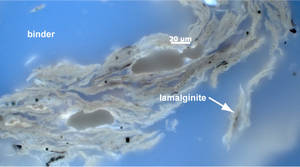 The effect of the isolation procedure on organic matter optical properties has been a past objective of ICCP round robin exercises. A review by Angeles Borrego of exercise results demonstrated that some questions remain open. Therefore a reactivation of the concentration working group activities was decided at the 2007 ICCP Meeting in Victoria.
Objectives
The main objective of the Organic Matter Concentration WG is to determine the effect of the isolation procedure on organic matter optical properties. This effect is being studied in relation to the maturity of the organic matter and the organic matter type.
A first exercise consisted of analysis of two samples containing terrestrial organic matter in order to minimize the difficulties for vitrinite identification. Subsequently samples from other origins were considered. The analyses performed were:
- Vitrinite reflectance of the whole rock sample
- Vitrinite reflectance of the kerogen concentrate sample
- Spectral fluorescence analysis of liptinite in the whole rock and kerogen concentrate sample.
A detailed report on the results from the first round robin on primarily terrestrial organic matter is available in ICCP News 45 (2008).
After discussion on the best way to proceed with activities it was accepted to use the same analytical approach for samples of marine origin. After another successful round robin (results available in ICCP News 49), working group results were published in the International Journal of Coal Geology in 2010.
In 2010 the WG first considered Type III organic matter from lacustrine environments, completing an evaluation of the effects of concentration on the three principal types of organic matter.
Building on results from the past years, the 2013 round robin exercise in this working group will use four low maturity samples characterized in the previous exercises, including oil shales from the Green River Mahogany Ledge in USA, Benin-Flank Basin in Nigeria, the Vale das Fontes Formation in the Lusitanian Basin, Portugal, and the Tremembé Formation in the Taubaté Basin, Brazil. Participants will examine the samples before and after kerogen characterization and measure the corrected fluorescence spectra of multiple liptinite macerals. This is important because the previous exercises of the WG have suggested that the kerogen concentration procedure may significantly impact liptinite fluorescence properties such as causing a spectral red shift.
Interested persons who wish to participate in the 2013 round robin are encouraged to contact João at graciano@geologia.ufrj.br. It is necessary that participants have microscope equipment capable of determining fluorescence spectra, which must be corrected by calibration with the Baranger lamp available from Carla Araujo at carla@petrobras.com.br. Participants will be required to return images of the measured subjects along with their spectral results.
Palynofacies
| April 5, 2015 | Filled under Com II |
|
Aim
 The Palynofacies working group was proposed by Isabel Suárez-Ruiz at the 2011 Porto meeting. Palynofacies is an integral part of organic petrology and there is need to better integrate this work into the efforts of the ICCP. Dr. João Graciano Mendonça Filho is the working group convener. At the Porto meeting several potential objectives for the WG were discussed including standardization of palynofacies approaches, and the production of an image atlas document that would supplement the Tyson Sedimentary Organic Matter volume. Another objective includes comparison of results obtained by palynofacies approaches with that determined by the traditional incident light techniques of conventional organic petrology.
Activities
2012
- Preparation of detailed proposal for a multi-year round robin exercise
- ICCP Meeting, Beijing – Presentation of summary of activities
2013
- Circulation of the 1st Round Robin Exercise
- Sample PWG1_Information.pdf
- Counting Sheet_PWG_Palynofacies_TWL_KC.pdf
- Counting Sheet_PWG_Maceral_RWL_WR.pdf
- Counting Sheet_PWG_Maceral_RWL_KC.pdf
- Minutes the Commission II – ICCP News No. 56, p. 22, April 2013
- ICCP Meeting, Sosnowiec – Presentation of summary of activities.
2014
- Report on the results of the 1st 2013 Round Robin Exercise
- Minutes the Commission II – ICCP News No. 58, p. 20-21, March 2014
- ICCP Meeting, Kolkata – Presentation of summary of activities.
- Circulation of the 2nd Round Robin Exercise
- Sample PWG2_pdf
- ICCP_PWG_Guideline_2014.pdf
2015
- Report on the results of the 1st 2014 Round Robin Exercise
- Minutes the Commission II – ICCP News No. 61, p. 21, March 2015
- ICCP Meeting, Potsdam – Presentation of summary of activities.
- Circulation of the 3rd Round Robin Exercise
- Samples PWG3 and PWG4_Information.pdf
- ICCP_PWG3_ Guideline_2015.pdf
- Counting Sheet_PWG4 sample_Palynofacies_TWL_KC.docx
- Counting Sheet_PWG3 sample_Palynofacies_TWL_KC.docx
2016
- Report on the results of the 1st 2015 Round Robin Exercise
- Minutes the Commission II – ICCP News No. 66, p. 16, March 2016
- ICCP Meeting, Houston – Presentation of summary of activities.
- Circulation of the 4th Round Robin Exercise
- Samples PWG5_Information.pdf
- ICCP_PWG5_ Guideline_2016.pdf
- Counting Sheet_PWG5_Maceral_RWL_KC.docx
- Counting Sheet_PWG5_Maceral_RWL_WR.docx
- Counting Sheet_PWG5_Palynofacies_TWL_KC.docx
2017
- Report on the results of the 1st 2016 Round Robin Exercise
- Minutes the Commission II – ICCP News No. 69, p. 14, March 2017
- ICCP Meeting, Bucharest – Presentation of summary of activities.
- Circulation of the 5th Round Robin Exercise
- Samples PWG6 and PWG7-Information.pdf
- ICCP_PWG6 PWG7_ Guideline_2017.pdf
- Counting Sheet_PWG_ 6 and 7_Maceral_RWL_WR.docx
- Counting Sheet_PWG_6 and 7 sample_Palynofacies_TWL_KC(2017).docx
- Counting Sheet_PWG6_Maceral_RWL_KC.docx
- Counting Sheet_PWG7_Palynofacies_TWL_KC(2017).docx
2018
- Report on the results of the 1st 2017 Round Robin Exercise
- ICCP Meeting, Brisbane – No activities
2019
- Circulation of the 6th Round Robin Exercise
- Samples PWG8 -Information.pdf
- ICCP_PWG8_ Guideline_2019.pdf
- ICCP Meeting, The Hague – No activities
2020
- No progress has been reported
2021
- No progress has been reported
2022
- No progress has been reported
SEM – TEM Editorial Group
| November 24, 2014 | Filled under Com I, Editorial Group |
|
Introduction
The Editorial Group prepared the “Electron Microscopy: SEM – TEM” Chapter for the New Edition of ICCP Handbook
Temporal Variation of Coals
| June 24, 2014 | Filled under Com I |
|
Some Results
See following graphics.
Maputo, 1.09.2019
Lopo Vasconcelos
Please cite as: Vasconcelos, L., Kalaitzidis, S., Cook†, A., Pickel, W., Sýkorová, I., Alfaro, G., Frank, M., Gerel, O., Markič, M., Petersen, H., Siquela, E., Životić, D., 2017. ICCP Databank on petrography of world coals. https://www.iccop.org/workinggroup/temporal-variation-of-coals/..
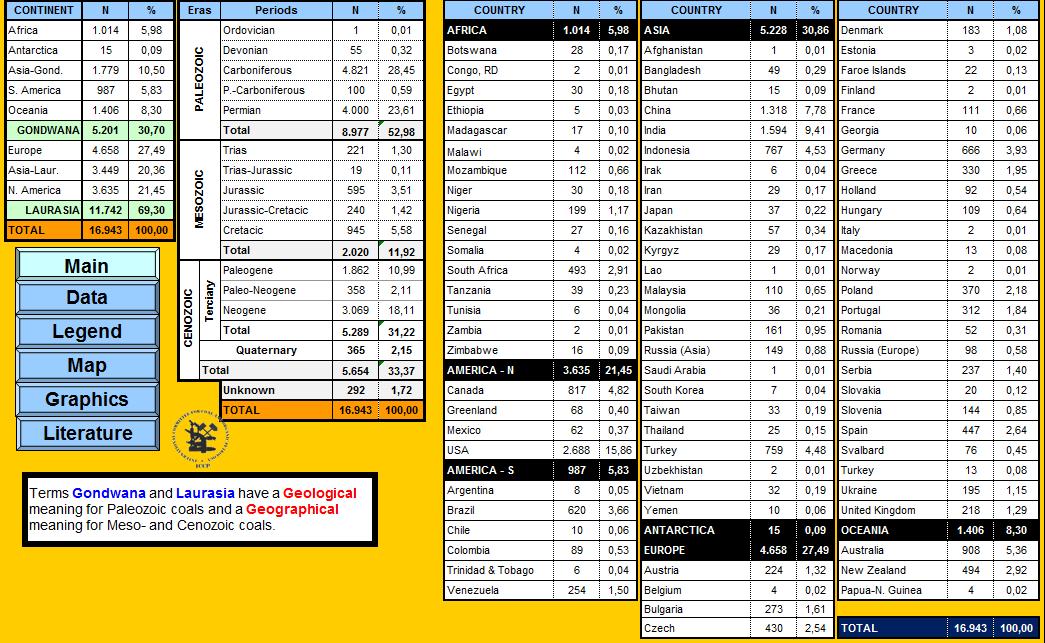
Summary of Data in Databank
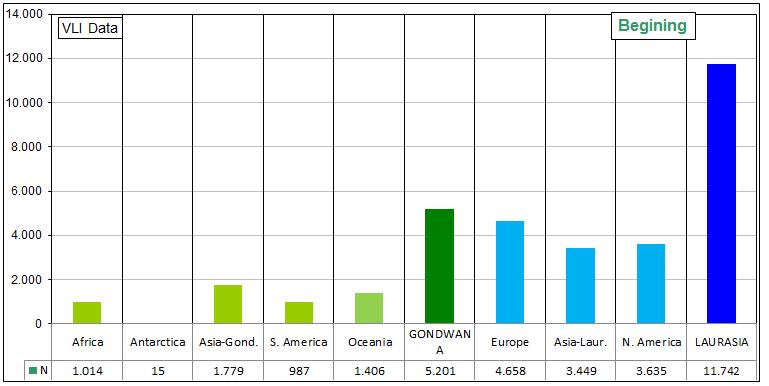
Temporal Variation of Coal – Distribution of the data by Continent
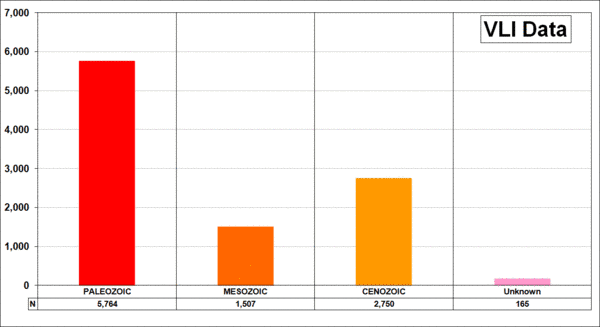
Temporal Variation of Coal -Distribution of the data by Age (Era)
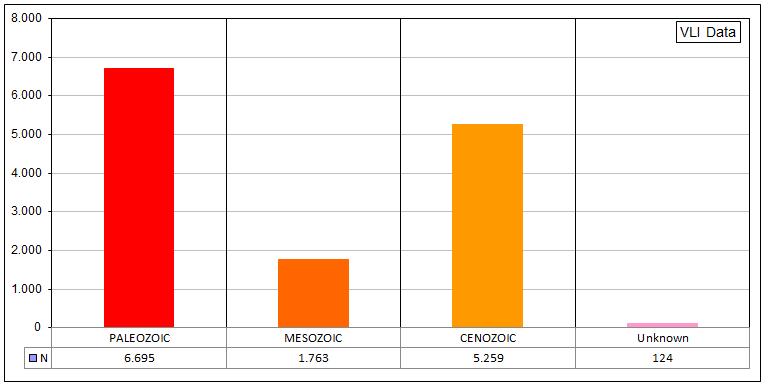
Temporal Variation of Coal – Distribution of the data by Age (Era and Period)
The Database has been collected over the years in the Temporal variations of coal WG. If you can contribute to the database with additional data, please contact the convener and join the WG
Objectives
In 1999 a statistical study carried out by Lopo Vasconcelos and published in Intern. J. Coal Geol., 40 (1999) 27-58 was presented in Bucharest during the 59th Annual Meeting of the ICCP, being this the first approach to the problem with the objective of observing the petrographic variations of coals with age. Besides temporal variations Palaeozoic coals also showed differences between environments of Gondwana and North Atlantic coals. The study did not consider environment, basin type, etc.
The objective of this WG is to study these variations, especially for Palaeozoic coals; it would be therefore interesting to study VLI-compositions within basins world-wide.
The Microscopy of Carbon Materials Working Group
| March 20, 2014 | Filled under Com III |
|
The Microscopy of Carbon Materials Working Group (WG) was activated at the 60th ICCP Meeting in Oviedo, Spain 2008, with the objectives directed to the microscopically characterization of carbon materials derived from coal and petroleum.
The WG is focused to consolidating and completing the existent methods developed for carbon materials structural and textural characterization:
Describe of the optical appearance of the carbon textures and identify the morphological differences as: optical texture and shape, optical type and size;
Use the previous exercises classification scheme to distinguish between different classes considered both for the optical texture (isotropic/anisotropic), and shape, optical type (punctiform, mosaic, fiber, ribbon, domain) and size;
Evaluate the origin of optical texture and the porosity development.
ICCP Meeting, Oviedo – Presentation of summary of activities.
Activities in individual years and publications:
(2009) 1-st exercise was focused:
- To identify the petrographic textures representing the structural organization of the organic matter corresponding to solid carbon precursors, as: coal-tar pitch coke, petroleum coke, calcinated anthracite;
- To describe of the optical appearance of the carbon textures and identify the morphological differences as: optical texture and shape, optical type and size.
The exercise consisted on 77 fields belonging to 22 different black and white pictures.
The 9 participants represented 5 laboratories and 5 countries (Bulgaria, Germany, Portugal, Romania and Spain).
- ICCP Meeting, Gramado – Presentation of summary of activities;
- Report on the results of the 2009 Round Robin Exercise
2010 activities: 2-nd exercise was focused:
- To identify the mesophase formation from the isotropic aromatic parent liquid to an anisotropic solid texture (nucleation, coalescing, mesophase coalescing final stage) of coal-tar pitches: binder pitch (type A) and impregnating pitch (type C) currently used as matrix precursors of many carbon materials.
- To describe the evolution of optical characteristics of pitches during heating up to 480, 500, 800 and 1000oC that influences their preparation within the production industrial steps.
The exercise consisted on 113 fields belonging to 42 different black and white pictures.
The 13 participants represented 9 laboratories and 9 countries (Germany, India, Poland, Portugal, Romania, Serbia, Spain, UK and USA).
- ICCP Meeting, Belgrade – Presentation of summary of activities
- Report on the results of the 2009 Round Robin Exercise
Publication: Predeanu G., Panaitescu C., Bieg G., Gómez Borrego A., Diez M.A., Kwiecińska B., Marques M., Mastalerz M., Misz-Kennan M., Pusz S., Suárez Ruiz I., Rodriguez S., Životić D. Thermal evolution of the coal-tar pitches structure studied within the Microscopy of Carbon Materials ICCP Working Group, The International Committee for Coal and Organic Petrology (ICCP) Newsletter, 51, (2010), 46-50. ISSN 1445-4793.
-
(2011) 3-rd exercise was focused:
- To use the previouse exercises classification scheme to distinguish between different classes considered both for the optical texture (isotropic/anisotropic), and shape, optical type (punctiform, mosaic, fiber, ribbon, domain) and size;
- To identify of the morphological differences occurred between three different samples of steel electrodes used: baked electrodes, re-baked electrodes and graphitized electrodes;
- To identify the interaction phenomena between calcinated petroleum coke and binders: binder pitch and impregnating pitch;
- To evaluate the origin of optical texture (not compulsory).
The conveners chose 116 fields belonging to 47 different black and white pictures.
The 13 participants represented 9 laboratories and 9 countries (Germany, India, Poland, Portugal, Romania, Serbia, Spain, Bulgaria and UK).
- ICCP Meeting, Porto – Presentation of summary of activities
- Report on the results of the 2011 Round Robin Exercise
-
(2012):
Provide and prepare for microscopical investigation the samples of carbon materials from the aluminum industry: anodes and cathodes blocks.
- ICCP Meeting, Beijing – Presentation of summary of activities
-
(2013) 4-th exercise was focused:
- To identify of the morphological differences occurred between two different samples of carbon materias used: in aluminum industry (anodes and cathodes blocks) which petrographic composition depends on the grain size distribution of the blended solids (petroleum coke, anthracite and the quality of the binding material-pitch coke).
- To use the previous exercises classification scheme to distinguish between different classes considered both for the optical texture (isotropic/anisotropic), and shape, optical type (punctiform, mosaic, fiber, ribbon, domain) and size;
- To evaluate the origin of optical texture (not compulsory).
The conveners chose 66 fields belonging to 40 different black and white pictures.
The 13 participants represented 9 laboratories and 9 countries (Germany, India, Poland, Portugal, Romania, Serbia, Spain, Bulgaria and UK).
The 8 participants represented laboratories and 7 countries (India, Poland, Portugal, Romania, Serbia, Spain, and USA).
- ICCP Meeting, Sosnowiec, Poland – Presentation of summary of activities;
- Report on the results of the 2013 Round Robin Exercise
Publication: POSTER at the 65th Annual Meeting of ICCP & 30th Annual Meeting of TSOP, Katowice, Poland. EXTENDED ABSTRACT 65th Annual Meeting of ICCP ICCP program and Abstract Book: Editors: Justyna Ciesielczuk, Monika Fabianska, Magdalena Misz-Kennan & Krzysztof Szopa, 108-109, ISBN 978-83-934-005-2-2.
2014 – 2015 activities:
Prepare and compile the manuscript for microscopical investigation the samples of carbon materials from the aluminum industry: anodes and cathodes blocks.
- ICCP Meeting, Kolkata, India – Presentation of summary of activities;
- ICCP Meeting, Postdam – Presentation of summary of activities;
- Report on the results and publication
Publication: ISI PAPER having all the participants as co-authors
Predeanu G. , Panaitescu C. , Bălănescu M., Bieg G., Gómez Borrego A., Diez M. A. , Hackley P., Kwiecińska B., Marques M., Mastalerz M., Misz-Kennan M. , Pusz S. , Suárez Ruiz I. , Rodrigues S. , Singh A. K. , Varma A. K. , Zdravkov A. , Životić D. Microscopical characterization of carbon materials derived from coal and petroleum and their interaction phenomena in making steel electrodes, anodes and cathode blocks for the microscopy of carbon materials working group of the ICCP. International Journal of Coal Geology, 139, (2015), 63-79.
2016 activities: 5-th exercise was focused:
- To activated carbons (coal and biomass origin) and precursors, (chars) of coal and lignocellulosic origin as well as materials in the stages undergoing pyrogenetic and activating reactions (I).
- Round Robin analysis were based on sample images taken by the conveners from real samples obtained and analysed in UPB and INCAR research laboratories
- The exercise was based on 11 sample type and 60 photomicrographs were provided by the conveners from:
- Romania: Coal /Lignite, (Oltenia Basin) Xylite Char Activated Carbon
- Spain: Coal/Semianthracite (Sovilla), Anthracite (Narcea) Activated Carbon
- The 13 participants represented laboratories and 7 countries (Australia, Bulgaria, Poland, Romania, Serbia, Spain, and USA).
- ICCP Meeting, Huston – Presentation of summary of activities 2016;
- Report on the results of the 2016 Round Robin Exercise
2017 activities: 6-th exercise was focused:
- To activated carbons (coal and biomass origin) and precursors, (chars) of coal and lignocellulosic origin as well as materials in the stages undergoing pyrogenetic and activating reactions (II).
- Round Robin analysis were based on sample images taken by the conveners from real samples obtained and analysed in UPB and INCAR research laboratories
- The exercise was based on 11 sample type and 60 photomicrographs were provided by the conveners from:
- Romania: Coal /Lignite, (Oltenia Basin) Xylite Char Activated Carbon (II)
- Spain: Coal/Semianthracite (Sovilla), Anthracite (Narcea) Activated Carbon (II)
- The 7 participants represented laboratories and 5 countries (Australia, Poland, Romania, Serbia, and Spain).
- ICCP Meeting, Bucharest – Presentation of summary of activities 2017;
- Report on the results of the 2017 Round Robin Exercise
2019 activities: 7-th exercise was focused:
- To activated carbons (coal and biomass origin) and precursors, (chars) of coal and lignocellulosic origin as well as materials in the stages undergoing pyrogenetic and activating reactions (III).
- In 2019 (the 7-th exercise) was based on: 10 sample type and 53 photomicrographs provided by the convener from:
- Romania: Coal tar pitch/Pitch coke/Activated Carbon (precursors for graphene materials) and Biomass/Biomass char/Activated Carbon
- The 13 participants represented laboratories and 7 countries (Germany, India, Poland, Romania, Serbia, Spain and USA).
- ICCP Meeting, Brisbane – Presentation of summary of activities 2019;
2021 activities
- Summary of the exercises between 2016-2019 targeting activated carbons, a group of carbon materials used on a very large scale
- The choice of these types of materials was not accidental but was based mainly on the experience of convenors, research scientists working in the field of the carbon materials
§ The collaboration between the conveners allowed the choice of some interesting samples to present in targeted photomicrographs, the way in which the optical microscopy can help, as a non-destructive method, the characterization of some high-performance materials.
2022 activities: 8-th exercise was focused:
- To biomass chars obtained from fruit kernels and other types of biomass materials of lignocellulosic origin in the stages undergoing pyrogenetic reactions.
- In 2022 (the 8-th exercise) was based on: 15 sample type and 30 photomicrographs and 15 examples provided by the conveners from:
- Romania: 8 sample type (7 biochars and 1 activated carbon) and 16 photomicrographs
- Poland: 7 sample type and 14 photomicrographs
- ICCP Meeting, New Delhi – Presentation of summary of activities 2022;
- Report on the results of the 2022 Round Robin Exercise
Thermal Indices
| January 29, 2014 | Filled under Com II |
|
Aim
This working group was established in 1988 at the ICCP Meeting in Aachen. The aim was to look at the various thermal indices (i.e., vitrinite reflectance, fluorescence, thermal alteration index, Rock-Eval, volatile matter, elemental composition) in respect to their sensitivity at different rank levels, their limitations and the correlations and comparabilities amongst them.
Objectives
The objectives of the working group moved between 1994 and 1998 to the standardization of fluorescence measurements and are now back to the original ones, incorporating other geochemical thermal indices such as isomerization ratios from biomarkers. Exercises from 2000-2010 looked at all of these approaches – comparison amongst different maturity parameters and standardization of fluorescence measurements on liptinites.
Activities
 The samples analysed over the years, exercises performed, and publication of results are as follows:
Series of coal and oil shales taken at different depth
- Pradier, B., (1994). ICCP Interlaboratory Exercise on Organic Thermal Markers. AAPG 1994 Annual Convention, Denver, Colorado, June 12-15, 1994.
Marine samples of different maturity
- Pradier,B., Vieth-Redemann, A., Araujo, C.V., Kalkreuth, W., Gomez Borrego, Hagemann, H., Hufnagel, W., Koch, M., Koch, J., Kuili, J., Laggoun-Defarge, F., Newmann, J., Petersen, H.I., Spanic, D., Stasiuk, L., Suarez-Ruiz, I., Thompson-Rizer, C., Wang, J., Wilkins, R., (1998). ICCP Interlaboratory Exercise on the Application of Microspectral Fluorescence Measurements as Maturity Parameter. 6th Latin American Congress on Organic Geochemistry, Margarita Island, Venezuela, October 18-22, 1998 (Conference CD-ROM).
- Araujo, C.V., Vieth-Redemann, A., Pradier, B., Kalkreuth, W., Gomez Borrego, A., Gurba, L., Hagemann, H., Hufnagel, W., Koch, M., Kuili, J., Laggoun-Defarge, F., Lo, H., Newmann, J., Spanic, D., Suarez-Ruiz, I., Thompson-Rizer, C., (1998). ICCP Interlaboratory Exercise on the Application of Microspectral Fluorescence Measurements as Maturity Parameters. Revista Latino Americana de Geoquimica Organica. 4, 41-49.
Joadja coal and equivalent oil shale
- Araujo, C.V., Kalkreuth, W., Cond�, V.C., Newman, J., (2000). Interlaboratory Spectral Fluorescence and VRFTM Measurements on Torbanite Samples from Australia. In: Proceedings 7th Latin-American Congress on Organic Geochemistry, Foz do Iguazu, Brazil, 153-156.
- Araujo, C.V., Barbanti, S.M., Cond�, V.C., Kalkreuth, W., Macedo, A.C., Newman, J., Pickel, W., Stasiuk, L., Volk, H., (2003). 2003 ICCP Thermal Indices WG: Summary of the 2002 Round Robin Exercise. ICCP News 29, 5-12.
Irati shale (presentation at the 2004 ICCP Meeting and internal report for participants)
Asturian carbonaceous and Posidonia shales
- Araujo, C.V., (2006). Thermal indices WG. Exercise year 2005. ICCP News 37, 17-28.
- ICCP Thermal Indices WG, (2006). Interlaboratory exercise of year 2005/2006. In: Proceedings Latin American Congress on Organic Geochemistry, Extended Abstracts, Salvador, Brazil, 91-96.
Victoria, 2007 – Thermal_Indices WG
Click the heading above to view the presentation given in Victoria.
Oviedo, 2008 – Thermal Indices WG
The results of the TIWG from the years 2007-2008 were presented in Oviedo. The exercises investigated a maturation series comprised by a set of three samples from the Neuqu�n Basin, Argentina. Vitrinite reflectance, spectral fluorescence of liptinite, and Rock-Eval analyses were performed. Results for Rock-Eval presented a good correlation, as well as the results for spectral fluorescence, in particular those of participants having recently calibrated their equipment with the ICCP lamp. Correlation of vitrinite reflectance results was very poor due to low vitrinite content of the samples. As it has been proven particularly difficult to find a natural maturation series, the convener proposed a new exercise based on an artificial maturation series produced by the hydrous pyrolysis procedure. As a starting sample the Posidonia shale was suggested.
Belgrade, 2010 – Thermal Indices WG
A presentation on comparison of correction functions and spectral fluorescence curves from telalginite on two different measuring systems (photometer and spectrometer) was given. Corrected spectra obtained by the two different measuring systems presented a very good correlation.
Porto, 2011 and Beijing, 2012 – Thermal Indices WG
Click the heading above to view the presentation given in Beijing.
Three samples (C3- Kappel; C5-Pinnell and D5- Columbia McCoy), representing a natural maturation series from the Devonian of the Appalachian Basin were provided by Robert Ryder (U.S. Geological Survey) for this exercise. Sample sets are distributed in the following way: 1) Sample Set in North America – Paul Hackley, 2) Sample Set in South America – Carla Viviane Araujo, 3) Sample Set in Europe – Angeles Gomez Borrego, and 4) Sample Set in Oceania – Jane Newman.
Participants received three polished blocks and were asked to provide results for mean random vitrinite reflectance and spectral fluorescence measurements of telalginite. Each spectral measurement reported should represent a mean value of about ten single measurements. The mean spectral curve should be adjusted with the correction function obtained by the calibrated ICCP lamp source (exercise of year 1996/97). Seventeen participants provided results for mean random vitrinite reflectance, one participant for VIRF and fourteen for spectral fluorescence measurements. The results have been summarized in a report which is intended to be submitted to the International Journal of Coal Geology or another peer-reviewed journal. This round robin exercise was the last planned for the working group and the effort will be closed following publication of the report.